Capital-markets infrastructure startup, client name withheld
A post-trade platform for derivatives
- Years
- 2024 to 2026
- Context
- Capital-markets infrastructure startup, client name withheld. Lead and only designer, via Godel Technologies.
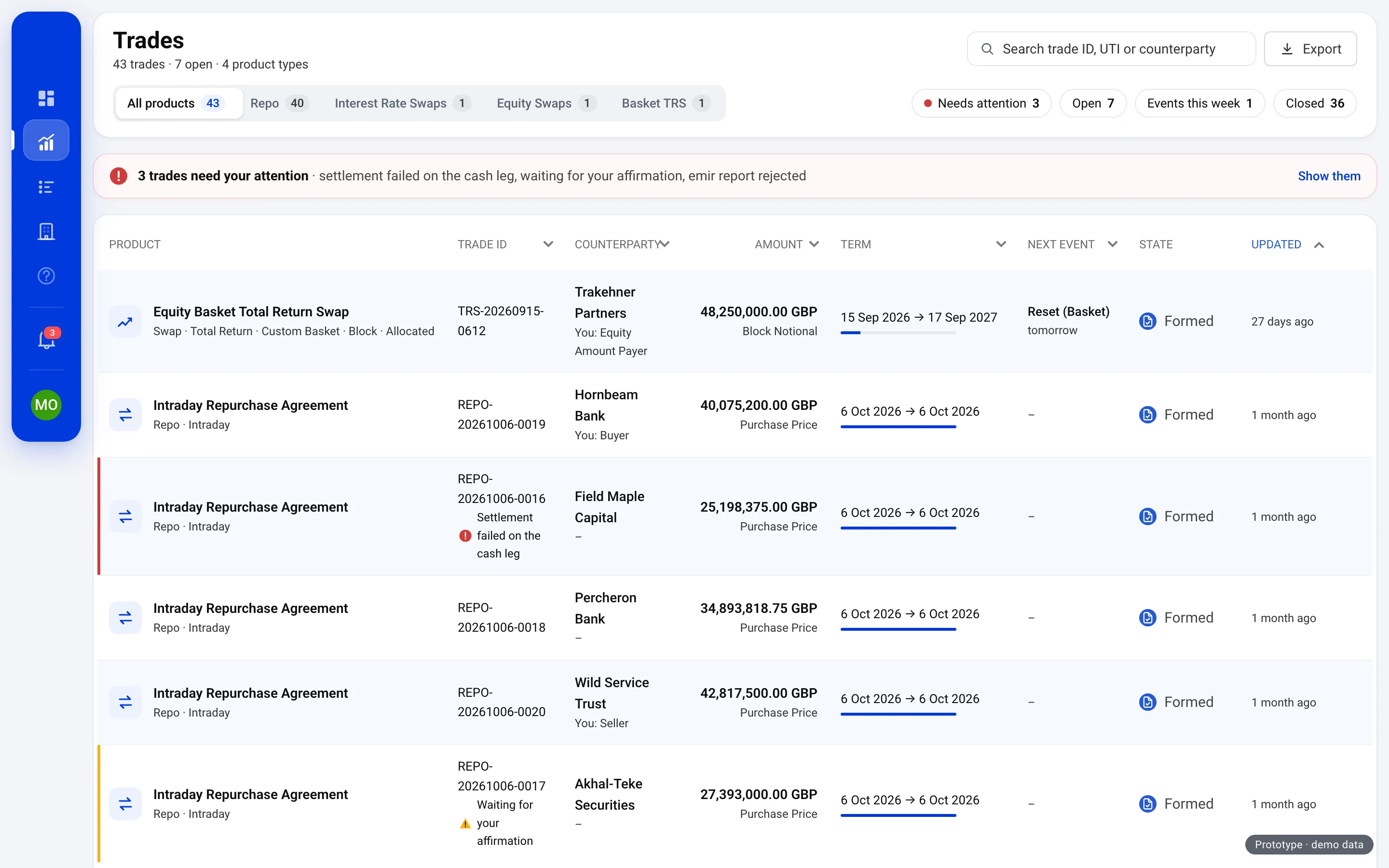
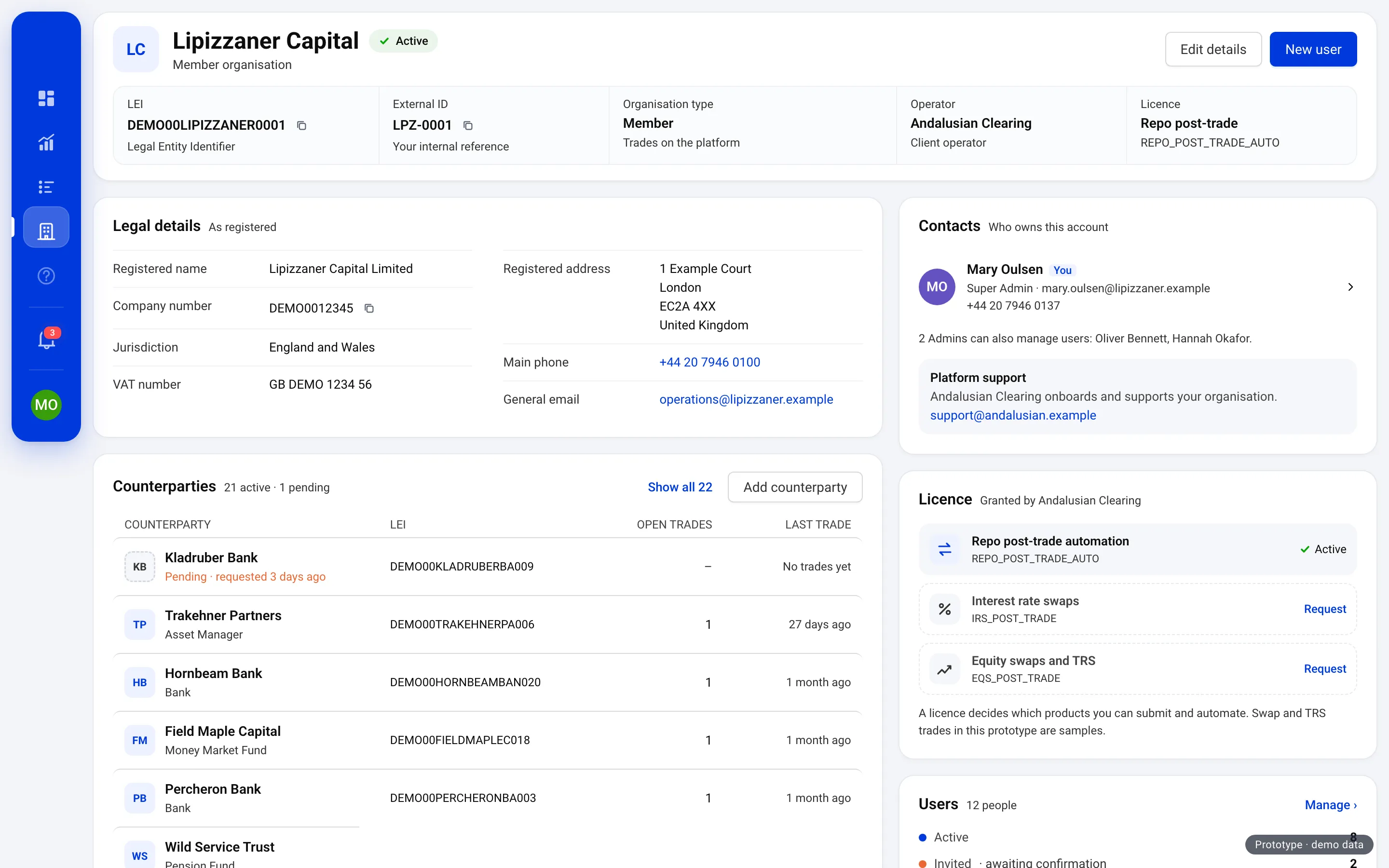
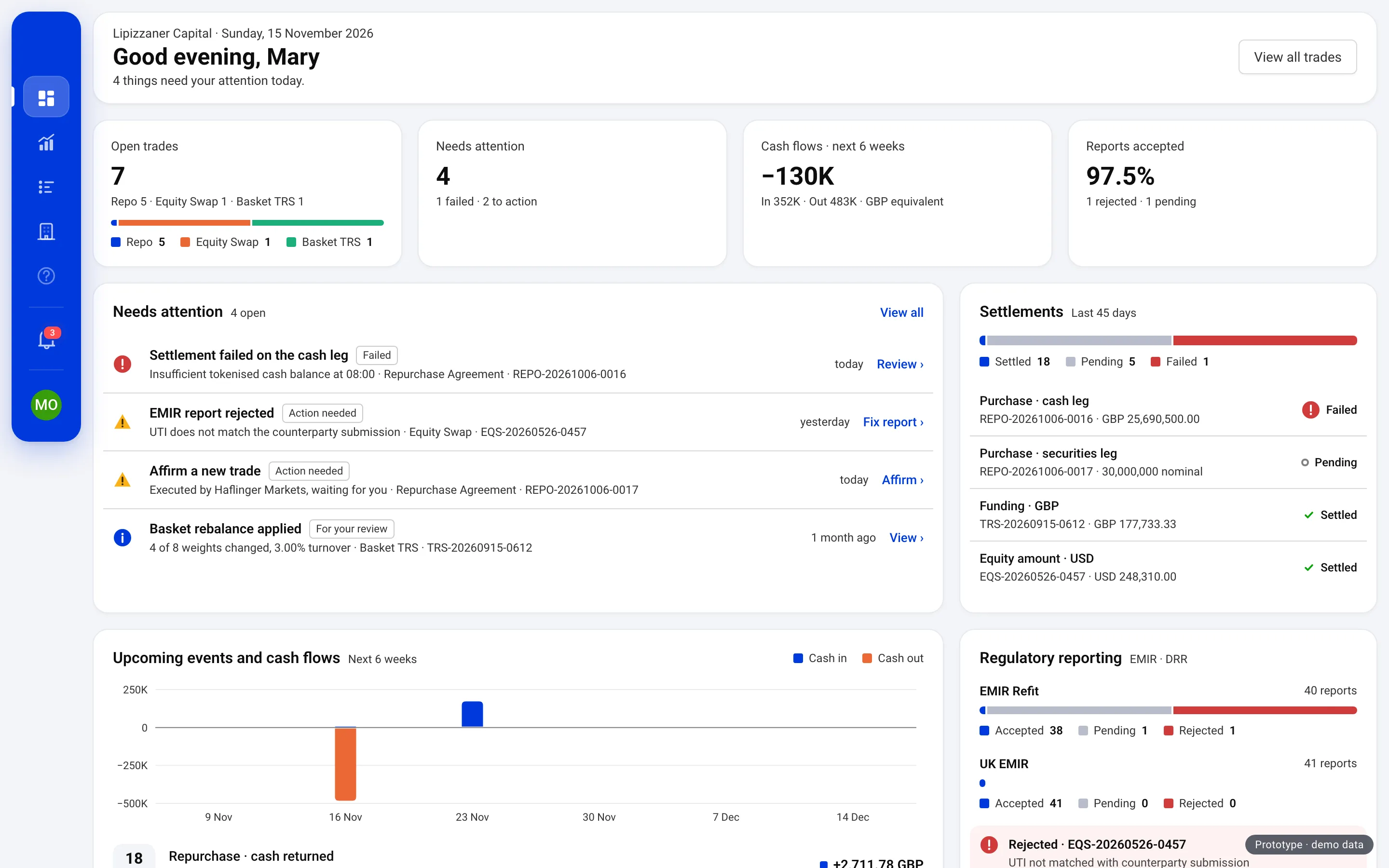
Some of the most complex trades in finance are still confirmed through spreadsheets, email, phone calls and a patchwork of systems, with heavy legal work and reporting to regulators on top. This startup turns every step into a digital record that proves the trade is right. I joined in February 2024 as lead and only designer. The company and its domain detail stay behind the NDA. The screens here come from my prototype and run on invented data.
The product
The product is API-first. The interface exists to show what it can do: executives and potential users need to see how it would work in their own business. The interface is also planned as an add-on service.
The problem
Every trade is a chain of steps across companies, people and systems. To digitise it, we first had to understand what each step was actually made of. We started with three types of trade: equity swaps, repurchase agreements (repo) and interest rate swaps.
What made it hard
The domain and the regulation. I spent a lot of time reading, talking to legal and CDM experts, and working things through with AI models to understand how it all fits together. It wasn’t obvious who the people were, how they work or how they depend on each other. There was a lot of data, the uncertainty was high, and I didn’t always have access to users.
What I did
I work every day with the founders, the engineers, and the legal and CDM experts.
- I made the data readable. I gave every view a visual form, so dense trade data reads at a glance. New views also put different data side by side, and people can draw conclusions they couldn’t before.
- I built prototypes that look completely real. We test the product with them and show it in demos.
- I designed a system for white-labelling, so the same product can wear a partner’s brand.
Why it mattered
We have run well over twenty demos for some of the best-known banks and financial institutions in the world. The ideas were shared work: founders, engineers and domain experts all shaped them. But my prototypes became the main way everyone, inside the company and outside it, understood where the product was going and what it actually was. They sat at the centre of the story behind the £18M the company has raised so far.
From Figma to Claude
Over nearly three years, the Figma designs aged. The live product still runs on them. When I learned what Claude could do, I asked for a bigger subscription and rebuilt the prototype with it: a console of widgets, assembled from the real components of the new design library. The engineers haven’t moved to Claude yet, so the new system isn’t in the product today. It’s ready for when they do.
The design library
I rebuilt the library from scratch and fixed what went wrong the first time: naming, hierarchy and organisation. Tokens come in three layers (primitive, semantic and component), and every component has the same name in Figma as in Storybook. Figma is the source of truth today; code will take over soon. When I add components I run the sync, so the prototypes use the same parts as the code. The work got much faster and far more systematic.
How the library syncs
One change in Figma reaches every prototype
- FigmaVariables and components. The source of truth today.
- TokensThree layers: primitive, semantic, component.
- UI libraryThe same components, in code.
- StorybookEvery component documented, with the same name as in Figma.
- ClaudeThe design system my prototypes are built from.
I run the sync whenever I add components. Next: code becomes the source of truth.
Brand/700Partner/600Interactive/PrimaryButton.Primary.bgComponents only read semantic tokens. To white-label the product, a theme points the semantic layer at another brand's primitives, and every component follows.